Why did you choose to write in your genre?
I’m interested in what fear does to our attention. An ordinary detail can take on a different meaning when we’re alone, tired, or convinced that something doesn’t quite fit. Psychological suspense allows me to explore that shift in perception and its consequences.
In The Silence on the Line, I wanted the investigation to unfold alongside something more intimate: the isolation of a person whose fascination with a case begins to take up too much of his life. I was interested in the point at which trying to understand the horror stops being something you can simply leave behind when you turn off your computer.
Can you share a little bit about your latest book?
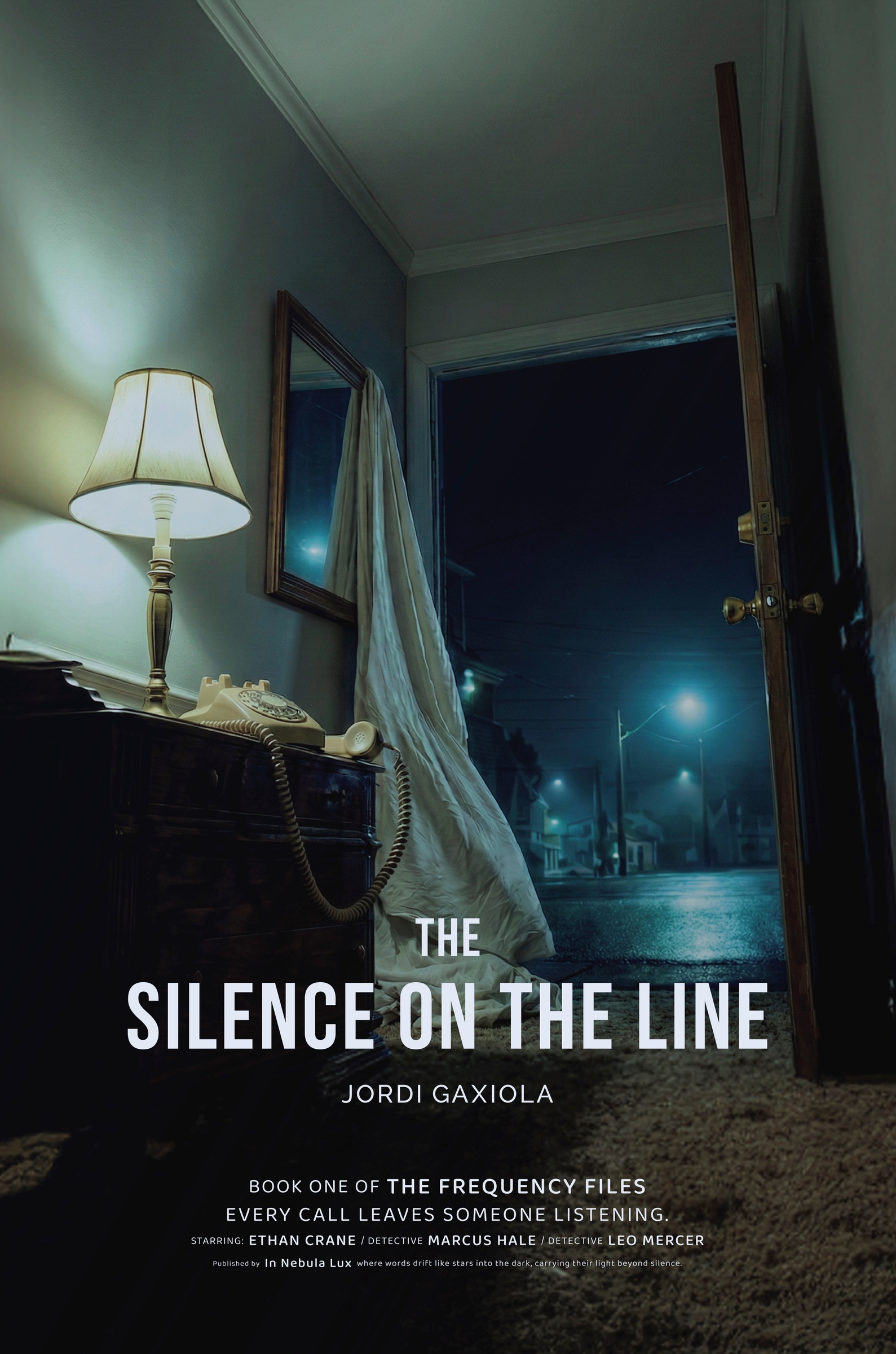
The book I’d like to talk about is The Silence on the Line, a psychological thriller set in late 2001. A serial killer leaves silent calls to 911, while Ethan Crane, a solitary copywriter, spends his nights running The Frequency Files, an online forum where users examine crimes and details the press overlooks.
Ethan is good at recognizing patterns. On the forum, that ability gives him something he struggles to find away from the screen: a place to belong. But the more closely he follows the case, the harder it becomes to keep it separate from his own life.
It’s a story about obsession, isolation, and the unsettling possibility that watching from a distance may not keep us safe.
The Silence on the Line opens The Frequency Files, a two-book series. Its sequel, Willow Arms, is coming soon and will complete the story.
What made you decide to sit down and start writing this book?
I wanted to explore those quiet spaces where a fascination can grow without anyone else noticing. I was interested in the apparent safety of someone following a crime from his apartment, convinced that the screen keeps him separate from what he’s watching.
I chose late 2001 primarily because of the technology. Online communities could already bring together people obsessed with a case, but away from the screen, many movements and encounters left fewer digital traces than they might today. Going online was also a deliberate act: listening to the modem, waiting, and entering another space. That transition felt powerful to me as a setting for the novel.
I wasn’t thinking about September 11 when I chose the year. Once I realized the story would take place shortly afterward, I incorporated that collective sense of vulnerability and uncertainty into its atmosphere.
That combination allowed me to bring together two experiences: a city trying to understand a threat, and a man who believes he can study it from the safety of his room.
Tell us more about your main character. What inspired you to develop this character?
Ethan Crane is a copywriter. His work requires him to pay attention to language, recognize patterns, and find details that will hold someone’s interest. I was drawn to the idea of bringing those abilities into a character who begins examining a criminal case with increasing intensity.
I also wanted those skills to contrast with his difficulty connecting with people. Ethan can analyze a conversation or notice something others have missed, but that doesn’t mean he knows how to reach the people in his own life. The forum offers him recognition and companionship without the same vulnerability that a relationship away from the screen might demand.
For me, that is an important part of his conflict. There is something understandable about his need to belong and to find meaning in chaos. What becomes unsettling is how much he might sacrifice to keep looking.
Do you work with an outline or plot sketch, or do you prefer to let a general idea guide your writing?
I usually begin with a starting point rather than a known ending. As I write, the characters and their decisions suggest different possibilities. I test those possibilities in my head, imagine their consequences, and follow the one that makes me most curious.
With The Silence on the Line, that freedom had to coexist with close attention to the story’s logic. Discovering the plot as I wrote didn’t mean I could neglect the chronology, the technical details, or what each character knew at a particular moment. As the story developed, I needed to check that its pieces still fitted together.
One of the most exciting discoveries was the forum. I had conceived it as a narrative device, but as I wrote the conversations, the users began developing a dynamic of their own. Their different ways of interpreting the case made that space feel increasingly alive.
What role does research play in your writing?
It depends on the story. With The Silence on the Line, I was writing about a period I had lived through. I remembered the ritual of connecting to the Internet, waiting for the modem, and having a mobile phone I used for calls, without a camera or Internet access. That experience gave me a familiar foundation, although I still needed to verify details: whether a technology was already available, whether certain places existed, or whether a procedure fitted the period.
The most painstaking work involved checking the forum’s chronology. I audited the dates and times of the posts to make sure the conversations aligned with the events of the novel. I also chose to follow the actual 2001 calendar. Thanksgiving, for example, takes place on the date it fell that year.
That review required much more work than reconstructing the technology. I wanted readers to be able to follow the conversations and examine the details without an inconsistency breaking their trust in the story. In a novel where paying attention matters so much, the dates and times deserved that same care.
What was the hardest thing about writing your latest book?
Sustaining tension when so much of Ethan’s experience takes place in a room, in front of a computer. I wanted readers to feel that something was changing even when, from the outside, very little seemed to be happening.
The challenge was to give that stillness consequences. A conversation changes an interpretation, a detail captures his attention, and the case begins to displace his everyday responsibilities. His world can become smaller even as the investigation takes up more space within it.
I also wanted readers to be able to build their own theories without feeling entirely comfortable with them. I’m interested in that moment when a detail seems to clarify something, then later makes you reconsider it.
What did you enjoy most about writing this book?
Building the analog atmosphere and bringing the forum to life. I’m drawn to the objects and small rituals associated with that technology: waiting for a connection, replaying a tape, or listening to a voice that has been recorded. They offer a very tangible relationship with time, memory, and attention.
I also enjoyed choosing the songs and artists. Music has always been important to me, and in this novel it participates in the story as well as contributing to its atmosphere. I was interested in how a familiar song could acquire a different weight when placed in an unexpected context.
Writing the conversations in The Frequency Files was another pleasure. Bringing together voices with different motives, some trying to understand, some insisting on their theories, and others drawn to the darkness of the case, gave the forum a personality of its own.
Want to learn more about Jordi Gaxiola?


Leave a Comment