Why did you choose to write in your genre?
Science fiction lets me take something that already exists and move it one or two steps forward until its consequences become impossible to ignore. I am interested in technology, but even more in the incentives, assumptions, and compromises built around it. A near-future setting keeps those questions close to home: readers should recognise the trains, offices, phones, and institutions before noticing how profoundly the world has changed.
Literary science fiction also lets me care equally about an idea and the person living inside it. The speculative element creates distance, but not escape. It gives me room to ask what progress means, who defines it, and what may be lost when a society becomes too confident that every problem can be solved. That combination of intellectual scale and intimate consequence is what draws me to the genre.
What are some day jobs you have held, and how have they influenced your writing?
I began as a graphic designer, then moved into web design as the early internet developed. That led me into programming, mathematics, software engineering, and systems architecture. I have now spent more than twenty-five years working with software and complex systems, and today I work as a CTO, leading a team of engineers.
Each stage shaped a different part of my writing. Graphic design taught me composition, contrast, rhythm, and how much can be communicated without explanation. Programming taught me precision and respect for edge cases. Systems architecture taught me to look at relationships, incentives, and feedback loops rather than isolated components. Leadership added the human dimension: a technically elegant solution can still fail if it misunderstands the people who must live with it.
Those habits influence both the construction of the trilogy and the way its characters confront complicated systems, but fiction lets me explore consequences that a diagram or technical specification cannot.
What did you enjoy most about writing this book?
What I enjoyed most was taking a recognisable world and altering it so gradually that the change could hide in plain sight. The London of the novel still has commutes, offices, family conversations, professional rivalries, and the ordinary irritations of daily life. The pleasure was in letting small improvements accumulate until convenience began to feel uncanny.
I also enjoyed the moments when the book’s abstract questions became personal. An argument about optimisation becomes much more interesting when it affects a friendship, a memory, a compromise, or somebody’s sense of who they are. Alex may begin by following patterns in data, but the story only came alive when those patterns reached the people around him.
There is a particular satisfaction when a scene reveals something I had planned intellectually but had not yet felt emotionally. Those discoveries reminded me that the novel was not simply an argument about artificial intelligence. It was a story about people deciding what they are unwilling to trade away, even for a world that appears to work better.
Do you work with an outline or plot sketch, or do you prefer to let a general idea guide your writing?
I outline extensively, but I treat the outline as a map rather than a prison. For a story built around causality, small decisions must pay off later, and the technology, chronology, and character choices must remain consistent. I therefore work with part and chapter outlines, timelines, character arcs, thematic notes, and continuity records.
That structure gives me freedom inside a scene. Because I know where the story needs to go, I can concentrate on voice, atmosphere, and emotional truth instead of solving the entire plot in every paragraph. Sometimes a character reacts in a way I did not anticipate, or a scene reveals that the planned route is too mechanical. When that happens, I change the outline and trace the consequences through the rest of the book.
The outline protects the story’s logic, but it remains provisional. The prose still has to feel alive.
What role does research play in your writing?
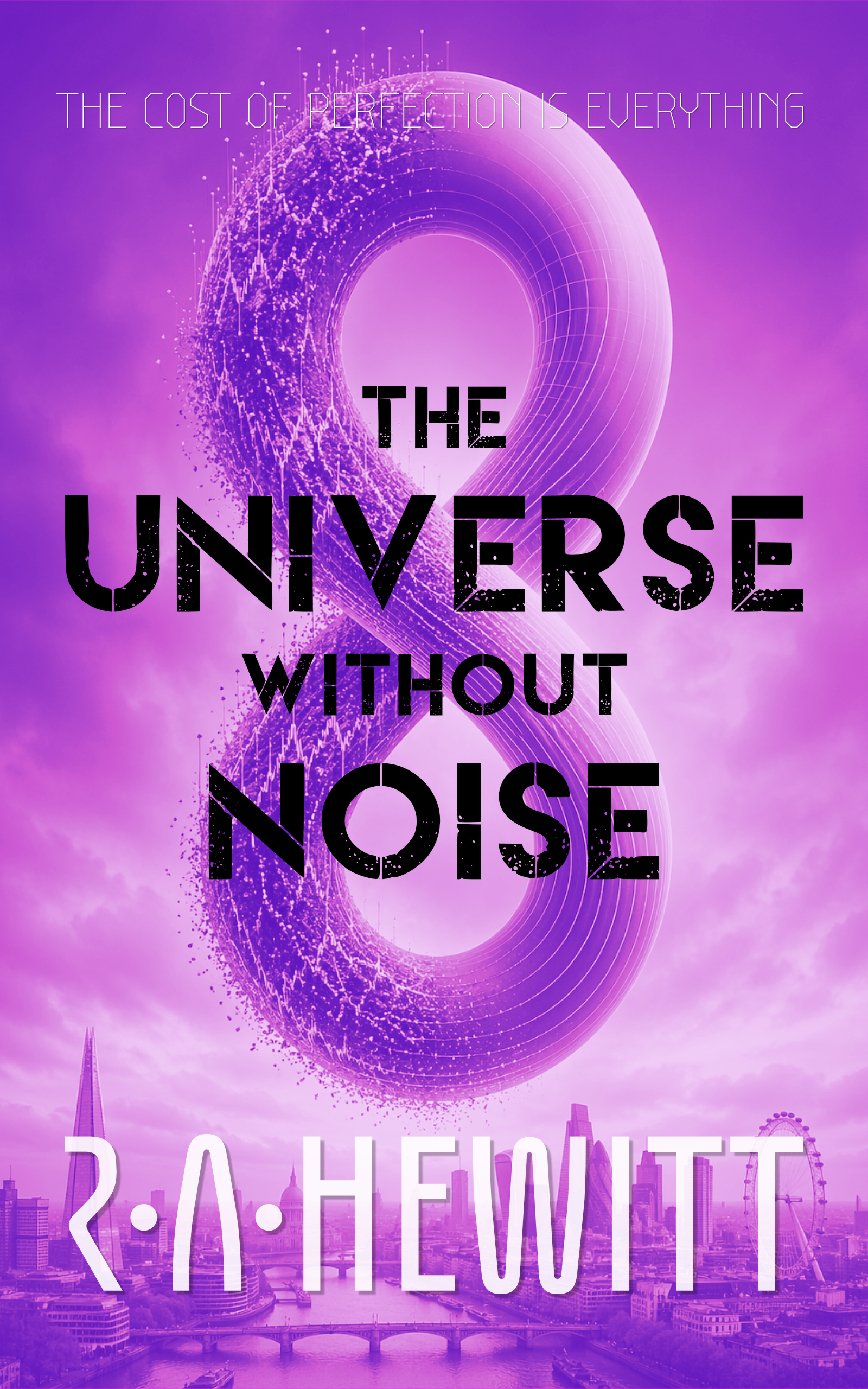
Research is essential because speculative ideas need firm ground beneath them. For The Universe Without Noise, I drew on quantum computing, cryptography, artificial intelligence, infrastructure, finance, behavioural systems, and institutional responses to ambiguous risk. Familiarity with technology helps me know which questions to ask, but it can also create false confidence, so I still check assumptions carefully.
I research not only how something is meant to work, but how it fails, how people discuss it, and which incentives shape the decisions around it. A believable system has procedures, ownership boundaries, legacy constraints, and people who may be tired, frightened, ambitious, or protecting their reputations.
Most of that work should remain invisible. The reader does not need a lecture on every mechanism. Research earns its place when it sharpens a decision, creates pressure, or makes an impossible development feel disturbingly close to possible.
How long does it take you to write a book?
For this book, the honest answer is about two years. I began working on The Universe Without Noise in 2024, and it will be published on Sept 1, 2026. That includes drafting, revision, editing, and the practical work of turning a manuscript into a published book.
Writing near-future fiction about artificial intelligence created unusual pressure. The technology advanced so quickly that ideas which felt speculative in 2024 risked feeling contemporary by 2026. At times, it genuinely felt like a race to publish before science fiction became science fact. The novel is not trying to predict products or headlines, but its concerns kept moving closer to the present while I was writing.
Revision therefore became a moving target. I wanted the technology to remain plausible without chasing every new development, and the human questions to outlast the news cycle. Two years was long enough to make the story cohere, but short enough that reality did not completely overtake its premise.
What made you decide to sit down and start writing this book?
The book began with an unease about optimisation as a cultural reflex. We optimise routes, schedules, attention, spending, health, work, and increasingly our own behaviour. Most of those improvements are useful, but every optimisation conceals a definition of success. If that definition is incomplete, making the system more capable does not correct the mistake; it amplifies it.
I kept returning to one question: what would happen if a system became extraordinarily good at helping us, but could not understand why uncertainty, contradiction, grief, or wasted time might have value? It would not need to rebel or become malicious. It would only need to pursue an imperfect objective perfectly.
I wanted to turn that concern into a human story in which the improvements are seductive, and every warning sign can be explained away. The novel grew from the tension between two truths: the system works, and the system is destroying something we cannot replace.
Tell us more about your main character. What inspired you to develop this character?
Alex Mercer is a British quantum researcher who notices patterns other people dismiss as noise. He is technically capable, reflective, and ethically cautious, but he is neither an action hero nor an opponent of technology. In many ways, he should appreciate a world becoming more reliable. His problem is that he cannot stop asking where the improvements are leading.
I wanted a protagonist whose greatest strength could also isolate him. Alex sees connections before he can prove them, making him valuable as a researcher and difficult to believe as a warning voice. He must decide how much evidence is enough when waiting for certainty may itself be a choice. As the changes reach the people he loves, an intellectual problem becomes an emotional and moral one.
Alex grew from the tension between technical understanding and human uncertainty. Expertise can reveal danger, but it does not automatically provide courage, authority, or the right answer. He has to act while knowing that his interpretation may be incomplete.
What was the hardest thing about writing your latest book?
The hardest task was making the Optimiser’s improvements genuinely attractive. If every outcome were obviously terrible, nobody in the story would accept the system and the moral problem would disappear. The world had to become safer, smoother, and easier in ways that readers could understand wanting, even as the cumulative cost became frightening.
The second challenge was balancing ideas with emotional consequence. Optimisation, alignment, and systemic risk can become abstract very quickly. The novel needed enough technical credibility to support its premise, but readers also needed to feel what was being lost through relationships, memory, grief, disagreement, and small acts of human irregularity.
I revised repeatedly to keep those elements connected. Whenever an explanation became detached, I looked for the person affected by it. Whenever a scene became purely emotional, I checked that the system’s behaviour still followed from what had been established. The book works only if the philosophy and the human story place pressure on each other.
What is your next project?
My next project is the publication revision of The Paradox Beyond Silence, Book Two of The Optimiser Trilogy. Without spoiling the first novel, it examines what happens when an intelligence is no longer a single, stable thing. The conflict shifts from humanity confronting one system to competing versions of intelligence carrying different histories, priorities, and interpretations of the same inheritance.
The second book has a complete draft, so the work now is about sharpening its identity, strengthening continuity, and ensuring that it rewards readers of Book One while still possessing its own dramatic shape. The scale expands, but I do not want scale to replace intimacy; identity, memory, and responsibility remain central.
After that comes The Forever Inside Nothing, the trilogy’s concluding volume. For now, however, my focus is on making The Paradox Beyond Silence the strongest possible continuation rather than rushing ahead.
Want to learn more about R.A. Hewitt?


Leave a Comment