What inspires you to write?
I create ‘swipe files’. And I fill these files – which have different writing purposes – with anything I encounter: posters, photos, and paintings; advertisement headlines; unique phrases in the body copy of a newspaper or magazine article or essay, which causes me to pause, and to think, “Now that’s interesting.” I add to these ‘swipe files’ regularly. And you know what? 99 times out of 100, it helps me to “get the fire lit”.
The key to writing good stories is to be open to new experiences; to have curiosity about a place, or its people. In writing How to Build a Champion, I was inspired by inner-city communities; street art and street artists; blended families; how seemingly disparate lives overlap and intersect; how we can choose to support each other when circumstances beyond our control throw our lives into a tail-spin; gentrification and its effects on a society; people with courage, quick-wits, resilience, who fill their lives – and the lives of those around them – with joy.
What have you written so far?
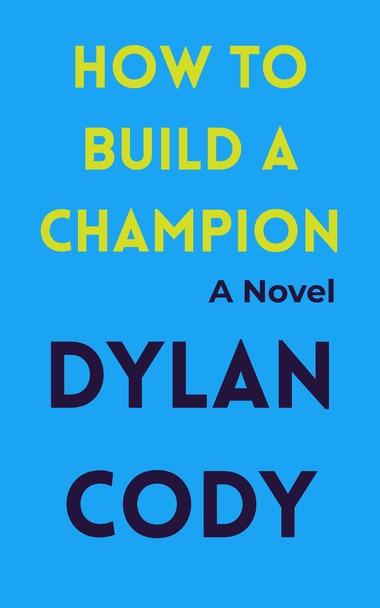
How to Build a Champion is the first book I’ve published under the pen name, Dylan Cody.
Do you work with an outline or plot sketch, or do you prefer to let a general idea guide your writing?
I couldn’t fly by the seat of my pants if I tried.
I begin with the writing’s purpose – is it to educate or to entertain the reader? (This purpose acts as an overarching aim which propels a project forwards; every scene I plot out is a ‘stepping stone’ in service of exemplifying the writing’s purpose.)
I think of the audience I’m writing for – what language do they use? What tone-of-voice are they most receptive to?
What does the reader need to ‘get’ by the end of this piece of writing?
What is the action I want them to take after reading the work?
In writing How to Build a Champion, I thought about the locations of where the story takes place; of the impact place has on people; of the personalities who would populate such a place, and the courage, optimism, resilience, and hope that they’d require to face the challenges placed on their intersecting paths. These dynamics informed the novel’s central plot, its conflict, and resolution.
As to the characters’ personalities, I thought about how their traits could shape a storyline. This led me to write detailed character biographies – drawing inspiration from different media sources – and these biographies influenced the development of subplots, adding flavour, ‘colour’, and texture to the story.
When I had a central plot and several subplots, I plotted the key points of each ‘scene’ onto post-its and smoothed them onto a few sheets of coloured card. This was my ‘flimsy’ storyboard, outlined. I could see what was going to happen, when, and could easily move each ‘scene’ around to see if this framework, this ‘flimsy’ storyboard outline, worked.
Lastly: I found a deck of blank flash-cards, and I detailed each flash-card with a numbered ‘scene’ including INT./EXT. location; the time of day; which day it was; a cast list of the characters who are in the ‘scene’ (so I could refer to my character summaries while writing); and a brief, expanded summary of what happened in the ‘scene’ from the ‘flimsy’ storyboard outline. Then, I created a playlist of music that felt right, to cement each scene’s ‘vibe’ in my mind; listening to these songs for scenes before I began writing. Then, I wrote the first draft of How to Build a Champion.
What role does research play in your writing?
Research plays an important role in my work. I can’t write or speak about somewhere, or someone, unless I understand the locality, or the person. As I mentioned, I draw inspiration from different media sources, and in researching names for the protagonist of my novel, How to Build a Champion, I stumbled across a website, Behind the Name, and I learned that the name Cassandra means “to excel, to shine”, and that people think that people with this name are “strong, complex, wholesome, natural, mature”. (At the time, I was reading photographer Cecil Beaton’s Self-Portrait with Friends – it’s a selection of his diaries – and I’d noted in Cassandra’s character’s biography his description of then-socialite, later diplomat and political activist, Pamela Churchill. Beaton’s observations of Churchill, “a bright, unspoilt, and girlish woman, … full of amusing and shrewd observation about people”, clarified the type of ‘character’ I had in mind.)
How long does it take you to write a book?
For this book: It took 4 hours a day – every day. I’d write the first version of a ‘scene’ in a morning; take a break for half an hour, then write the ‘scene’ over with any bits I’d noticed were ‘missing’. Then, I’d put it to one side. On the evening, after my mind had worked on other things, I’d write the ‘scene’ over again, then file the sheets of A4 paper into a plastic wallet and put the day’s work out-of-sight. (Not for any superstitious reason; I’d ‘clocked-off’ and I didn’t want to be reminded of work.) I followed the same rhythm – day-in, day-out – for around 8 weeks, until the first draft was finished. (If we factor in everything from research to first draft, the many iterations of the story until it was ready for copyediting, proofreading, and formatting? About 18 months over a period of 3 years.)
What advice would you give to aspiring authors?
To quote an answer I gave on Quora: “Writing a book, and writing the promotional materials to accompany the book, requires you to wear two different hats. It’s great to have an idea in mind for a story you want to tell. However, if it’s a time-sensitive topic, it can be pretty difficult to find the time to write, edit, and do all the due diligence you need to before promoting it – or even in tandem with writing the book – so you don’t leave yourself open to any legal troubles further down the track.
What I’m trying to say is: context is key. An author needs to ask themselves: Why are you writing this story – is it because you have a need to get this story written down, for yourself, or are you writing with an audience in mind and so creating a saleable product? (Because the end goal, and so the ‘success markers’ along the way to completing these respective journeys are very different.)
When you know what it is you want to do, and why, you’ll be in a much better space to plot out not only your book, but also the best way to bring it to market (if that’s what you’ve decided to do) and reach your target audience. (That said, even then, ‘success’ isn’t guaranteed. But then, that depends on how you define ‘success’, and how much cash you’re willing to throw at promoting ‘the product’ aka your book.)”
Can you share a little bit about your latest book?
How to Build a Champion is a picaresque story of courage, resilience, quick wit, and joy, which follows Cassandra, a bright, outspoken young woman, through a British summer in a multi-cultural working-class neighbourhood, peopled with personalities, where the inner-city skyline changes in ‘fits and starts’.
Living among artists, musicians, trade-unionists, bohemians, students, writers, and educators defining what it is to live ‘successfully’ in the face of ‘progress’ in their shared city, Cassandra works with her uncle, Bobby, and his partner, ‘Toria, in their community-minded osteria. All is well, until their landlord, Harry, throws their lives into a tail-spin when he considers an offer from speculators, gentrifiers, and property developers who seemingly know the price of everything and the value of nothing. Raising their voices in opposition, Cassandra and her friends, street artists Mc, Pat, and Teddy, band together in a fly-by-night adventure, making mischief in their fight for the osteria, while a cunning lifestyle journalist ‘helps’ their cause.
How to Build a Champion asks readers to question their first impressions; to look twice at what they see, and encourages its readers to live life fully, whatever their circumstances.
Who are some of your favorite authors that you feel were influential in your work?
Colette, Cookie Mueller, Eve Babitz, Laurie Colwin, June Sarpong, Selina Todd, Stefano Bloch, Mikki Kendall, Peter De Vries, Bertrand Russell, Carl Rogers, Virginia Satir.
If there was one thing you could do to change the publishing and literary world, what would it be?
Make it much, much easier for independent authors to find ARC reviewers for their works. (Actually, finding book-reviewers for independent authors’ works in general.)
Tell us something unique about you.
I’ve travelled halfway around the world 4 times.
Want to learn more about Dylan Cody?


Leave a Comment