What advice would you give to aspiring authors?
Well, certainly I would recommend Joseph Campbell and all of his works, including The Masks of God. And also, John Gardner’s works in regards to his books on the writing craft. And I would advise younger writers to discover those as quickly as possible.
For Joseph Campbell’s side, it’s more about the philosophy and the culture of civilizations and societies throughout the span of history. And John Gardner really loved the craft of writing. And when you read his work, his books on the art of fiction or on moral fiction, his passion really comes through. And I wish I would have discovered those in my twenties. I didn’t discover those until I was in my thirties. So roughly fifteen years after I had already started writing. Also, The Art of Fiction, which is where John Gardner describes how all great literature is derived from two basic plot points: a journey or a stranger comes to town. My novel Cowboy is both.
So, I felt like I was wandering in the desert before I came across Joseph Campbell and John Gardner and their whole collection. Just read as much of their entire collection as you can.
With Joseph Campbell, you’re going to get the history of civilization. A more anthropological study of people and society. But with John Gardner, you’re going to get the more passionate desire for actually the craft of writing and how to treat it as a professional writer. He’s very blunt in regards to it being hard work. It’s hard, hard, hard work. And it’s not for everyone to sit alone in a room with a pen and paper. And to write and create drafts and then rework those drafts over into a state of impermanent perfection. Meaning you need to get it as perfect as you can. But you also need to understand it will never be truly perfect. And that’s okay.
Because one thing I learned over the last thirty years is that sometimes the imperfect qualities of anything, that’s what gives that item or that object or that person or that book or that story those imperfect qualities, and that’s what give it character. And that makes it really, truly, and deeply profound.
What role does research play in your writing?
Well, my research process always begins with the setting, the time period. For example, when I’m following Cowboy — or, A Communion of Saints, I have a general idea. However, that’s not good enough. That’s not the gold standard. What I need to know is the exact detail, as close to humanly possible. It’s trying to be perfect without being perfect — the impermanent perfection.
Impermanent perfection means you’re never going to be perfect, but you should try to be perfect, especially with your research. Writers should always strive for the impermanent perfection. That includes grammar, sentence structure, character motivation, character descriptions, consistency.
With Cowboy — or, A Communion of Saints, I know the land of Texas and the people of Texas. I lived with them growing up for twenty-five years. Being away from Texas and away from all that makes those memories more vivid, more distinct, more concrete, and more heartbreaking. The land hasn’t changed much in a hundred years — outside town, a hundred yards off the highway: rattlesnakes, horned frogs, roadrunners, mesquite, caliche, red dirt. The smell of oil out west — we called that smelling money. Around 1901. Oil was booming.
I need specific details: how far apart the towns were, which existed back then. I chose Dickens as the final city. The town was growing back then, six hundred people. I researched the hotel name — found the Clay Hotel, owned by the Clays; it appears in my book. At that level of detail, I triple-check, using scholarly sources.
Eyewitness accounts are hard for 1901 but useful. You can read descriptions from people alive then, but that takes work to find credible and reliable sources (which is absolutely worth putting in the extra work and effort), and to be accurate.
The city of Dickens, however, came naturally to the story. Cowboy was heading north with Fishgirl, and the next town they could possibly stop at was Dickens. The town fit so well in the story, and I immediately noticed the connections to the literary side of things, but it was a happy accident, one coming from the nine muses, I suppose.
Joseph Campbell wrote and discussed the museum in New York City that inspired him. J. D. Salinger, the author of Catcher in the Rye, wrote a similar museum scene with Holden Caulfield and Phoebe. This is slightly unrelated to my Texas novel, but you can always find people discussing or writing about the past in great detail.
Eyewitness accounts are always good, but it’s hard because how many people are still alive now who were alive back in 1901? So that’s hard. But you can also read people’s descriptions, like people who lived in that time period. You can also read what they were going through. So, you can read books or essays or journals from people who lived and existed back then. Maybe those individuals were published in 1950, but they were alive in 1900. Joseph Campbell writes about his time growing up in New York City and about the museum there, inspired by the Native American display as a young boy, which inspired him to learn about cultures — a very similar museum J. D. Salinger, the author of Catcher in the Rye, wrote about, with Holden Caulfield going in with Phoebe.
My point: you can always find ways to authenticate the eighteen or nineteen hundreds. Written documents from historical societies and organizations — go to those first, then eyewitness accounts, then tertiary evidence: books, essays — and short stories and fiction I often avoid and stay away from, because these can be less accurate and harder to validate, harder to be certain about the accuracy and validity of the information and details.
But to me, government documents are some of the best materials. I want to see the map of Texas in 1900. So, I had for the whole time, the very first thing I did from day one, I had a huge map of Texas that was published in 1901 in color, and I took that colored-printed map and covered it in plastic, I laminated it, so the paper wouldn’t be ruined.
The map I used for this novel, for Cowboy, was from the University of Alabama’s historical maps, specifically the Rand McNally and Company map dated 1901 — you can see it here. And that is an official map.
I also took the electronic version of the same map, and I zoomed in to different counties back in 1901, the cities they had then and specific regions, and I printed those pages out as well, just so I could follow the journey of Cowboy and Buddy going through the landscape more easily.
What made you decide to sit down and start writing this book?
The moment or real-life event that inspired me to write Cowboy — or, A Communion of Saints was my son, Thor. He was six years old at the time, back in 2022, and he was playing a Minecraft game. There was a little boy, and he had a little horse that was gray and white. That moment of him playing and having so much fun just reminded me of when I was a little boy.
When I was a very little boy, I had a toy, kind of like a little ceramic or plastic horse, gray and white, exactly what Buddy looks like in the novel. It took me back to those feelings of being a little boy again, and to the hardships I went through in my family when I was ten years old. Going through a divorce, from a happy home to a very empty and cold home.
I imagine that for the protagonist of Cowboy, whose name is Cowboy, fifteen years old, from a happy home to a cold and empty home. He gets on his horse, Buddy, gray and white, and starts riding and riding and riding on this journey.
One night in October 2022, I couldn’t sleep and kept thinking about this boy who takes the name Cowboy. So, I got out of bed, around four in the morning, and started writing the first pages of the novel at a kitchen table with only the light on. I wrote so much and so well, I decided to keep doing this routine, because it felt like the nine muses were visiting me and whispering this book into my ear, and all I had was a small light, a pen, and a small Moleskine notebook. Nothing else. And it would be four or five in the morning, and everything outside was dark, and the story just flowed so well.
And at the time, I also remember thinking, Thor is six years old at this time, and I started writing this novel because I was working on my A Time To trilogy also. I was working on Moscow, a good quarter done, but I put that on pause because if I write Cowboy, I’ll probably be done in about four years. My son will be ten years old, I thought at the time. I said this is perfect. Cowboy will come out when he’s ten. Moscow can wait.
That’s really what sparked the moment and the creation of the novel Cowboy — or, A Communion of Saints.
Can you share a little bit about your latest book?
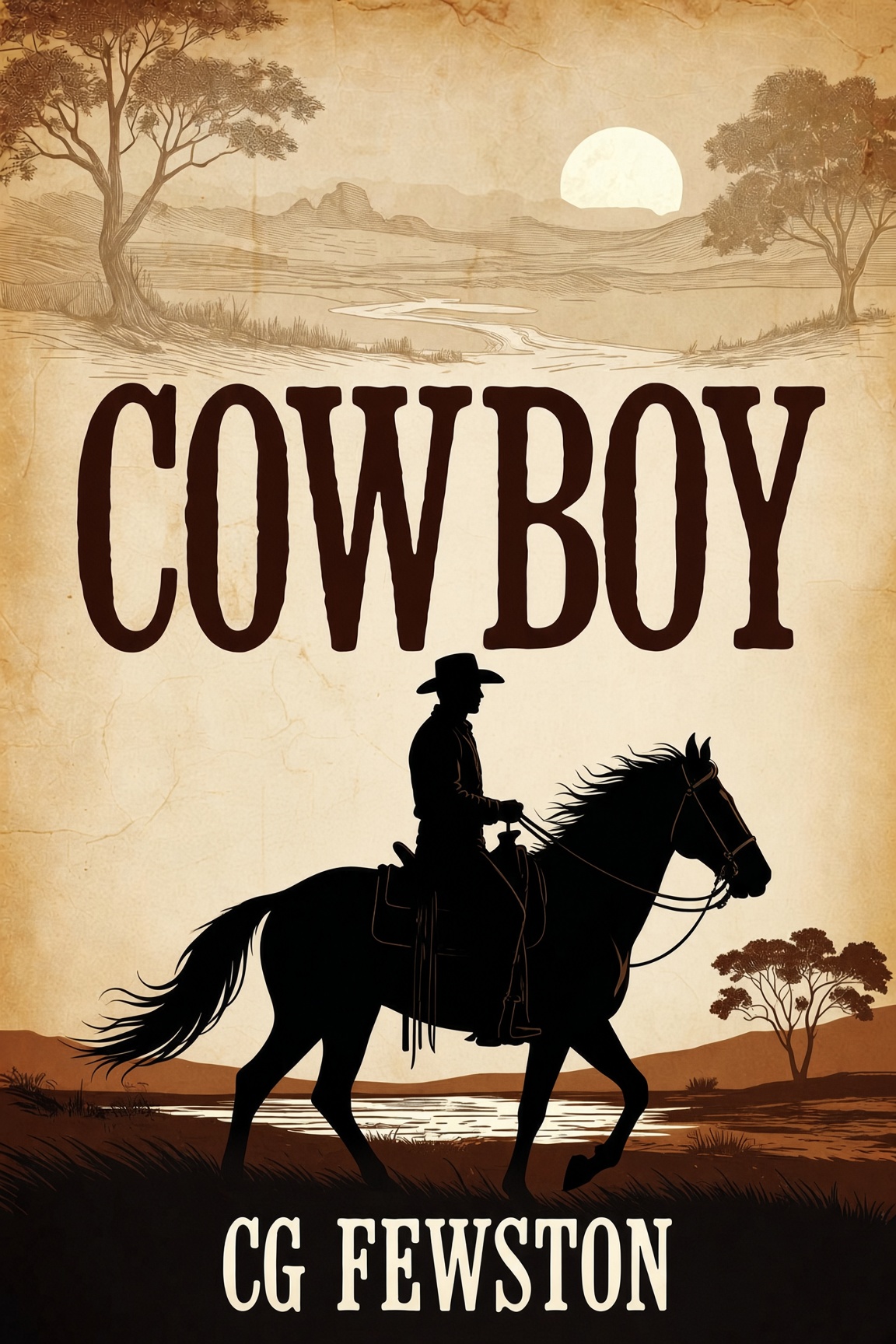
Late in 1901, after the frontier has been declared closed, two riders cross Texas. One is Henry Bartholomew Roberts, an older man with stories he will not tell until night — Bowdre, Rudabaugh, Wilson — and with a way of treating a boy’s chosen name as enough. The other rider is a fifteen-year-old boy who believes his birthday and his name are cursed. He stops short of his Christian name. He says, “Name’s Cowboy.” Henry answers without hesitation.
The book stands with journey novels, such as The Adventures of Huckleberry Finn, Where the Red Fern Grows, Hatchet, All the Pretty Horses, and Don Quixote.
How long does it take you to write a book?
The book Cowboy — or, A Communion of Saints took roughly four years, from October 2022 to October 2026. My son was only six years old when I first started this book, and now he is ten. The book and my son have both grown over the last four years.
Other books vary according to how long the story itself needs to take to become completed and finished. For example, I started my novel Conquergood & the Center of the Intelligible Mystery of Being back in 2007, when I lived in Ho Chi Minh City, Vietnam. I was 27 years old at the time. I worked on that novel on and off for about a decade or more until I finally published it (to rave reviews) in 2023. That process of inception to final release took me 16 years.
Are you a full-time or part-time writer, and how does that affect your writing?
I’m a full-time writer, and I enjoy it very much. I wake with my son early and then shower and have breakfast at the table, our normal routine. Then we go to school, and I am back home around 8:15 in the morning. I do normal housework, like laundry, and I have a specific time to start working each weekday morning, and that is 9:30 a.m., and I work until after one in the afternoon, but no later than two.
The day-to-day routine of setting a specific time to stand at my desk (because of a bad back, I have a standing desk) to type, or sit in a comfortable chair to write by hand in a small Moleskine notebook, treats my writing with the utmost seriousness it deserves, and I would have it no other way.
I wrote Cowboy — or, A Communion of Saints by hand in small Moleskine notebooks over the course of four years, and I did most of that writing between 4 a.m. and 6 a.m. every morning before my son would wake up for school. He was six years old when I started waking early to write the story by hand at the kitchen table with only a small light on to guide me, and only recently, within the last week or so, did he realize and fully understand that I would wake before he did to write, because he was too young at the time to know. He’s ten years old now, and he has enjoyed watching the journey and process and the unfolding of this book, which has been a great part of my family for the last four years.
What have you written so far?
Over the last twenty years, I have written and published a ton of short stories in literary magazines, dozens of general news articles, over two hundred book reviews, and my new novel Cowboy — or, A Communion of Saints is my ninth book, and you can read all about me and my literature at my website. You can even listen to or read several of my short stories that can be found in the Menu section of my website under “The Big Five” and “A Season in Rome,” which are both collections of short fiction.
Who is your favorite character in your book and why?
I don’t have a single favorite character from this book, because most, if not all, these characters stand out and are wonderful to behold. Cowboy, the boy, and his horse, Buddy, are amazing to follow on their journey of growth. Henry has his secrets, and they are interesting to see from the viewpoint of a child and from the viewpoint of an adult (by the book’s end) and his connections to the Wild Bunch gang. And then there is Fishgirl, but I won’t spoil anything for you here. You will just have to read the book.
But I do have a favorite line in the novel which resonates with me after all this time. My favorite line from Cowboy — or, A Communion of Saints is when the boy is asked by Henry about the Old West, if it was dying or if it was dead. And Henry asks the boy, Cowboy, what he thinks about it. And Cowboy says, “I reckon it’ll stay alive as long as we keep it alive.”
And for me, that says a lot about life in regards to anything. Family, culture, friendship. Those things will stay alive as long as we keep them alive. But you have to put effort into it. You got to spend the energy. And you got to work at it. And sometimes that work is not easy work. But even when it’s hard, you’ve got to try and do your best at it. And like the boy says, it’ll stay alive as long as we keep it alive. And sometimes that can mean that it’ll work as long as we put in the work. So, whatever we are trying to keep alive, we need to make the effort to keep it alive. And it’s really up to us.
Want to learn more about CG Fewston?


Leave a Comment