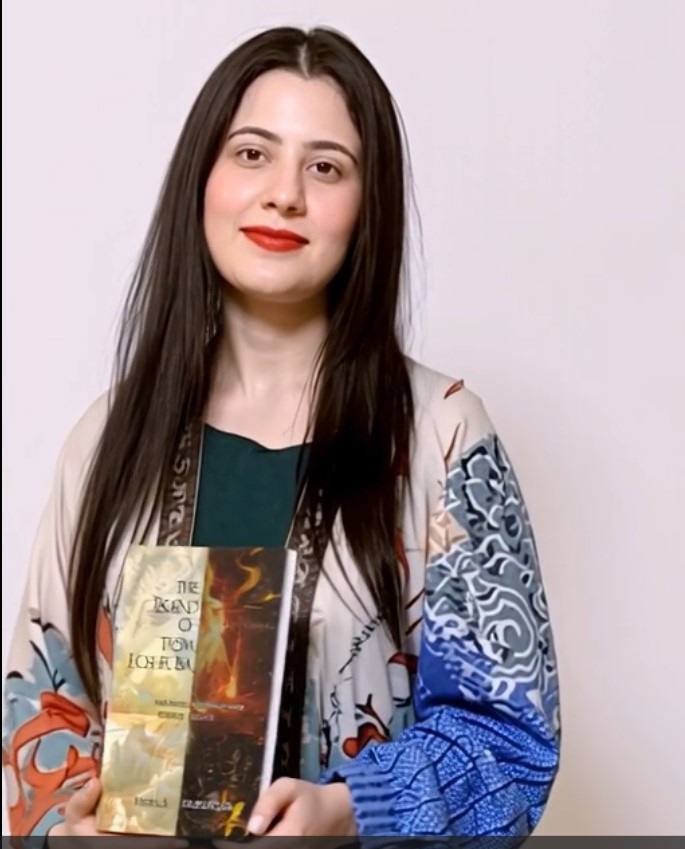
What inspires you to write?
I think the moment I first considered myself a writer wasn’t when I published a book, or when someone called me an author — it happened long before that. It was quiet, almost sacred, like a realization that sneaks into your heart before your mind is willing to accept it.
I became a writer the day a blank page stopped frightening me and started calling me.
I remember sitting alone one evening after another draining day of my Bar Vocational Course, my desk buried under case files and responsibilities. In the middle of that structured, disciplined world, my father’s voice returned to me — the way he had once placed the old Tilsim-e-Hoshruba volumes in my hands and said, “Translate them. The world deserves this magic.” At that time, I wasn’t ready. I had hesitated, resisted, even argued with myself that I was meant for law, not storytelling.
Still, almost reluctantly, I had begun translating a few pages… then chapters… then an entire book — only to delete it all because it didn’t feel alive, not in the way my heart demanded. That memory rose in me that evening, sharp and undeniable. It reminded me that I had always been a wild horse — running where the heart calls, even if the path makes no sense to the world.
So when I opened a blank document that night and typed a single sentence, that hesitation finally broke. The page wasn’t just a page anymore — it felt like the moment the reins slipped from my hands. A doorway opened, and everything I had been suppressing for years — imagination, wonder, magic, longing, the dream my father planted — rushed through like a storm that had been waiting for permission to breathe.
That day, I didn’t “decide” to become a writer. I realized I had always been one.
Because long before I wrote novels, I used to collect moments like other people collect souvenirs — a stranger’s expression at a traffic signal, the way sunlight falls on old books, a sentence overheard, a dream half-remembered. I would tuck them away quietly, not knowing I was preparing myself for stories that didn’t yet have names.
I think that’s what being a writer truly is: you start seeing the world in metaphors before you ever dare to call yourself a storyteller.
So when did I consider myself a writer?
It was the day I finally admitted that the stories inside me were not just distractions — they were a responsibility. A pulse. A calling. Something Allah placed within me long before I ever held a pen.
Publishing came later. Recognition came later. But the identity… that came the moment I surrendered to the truth that I was born to create worlds — not because I wanted to, but because I couldn’t imagine living any other way.
What have you written so far?
I have written stories that feel less like projects and more like pieces of my soul scattered across pages. My main work is the Tilsim Hoshruba series, a reimagined saga inspired by the ancient folktales my father once told me — tales that carried more magic than the world ever gave them credit for. What began as a simple attempt to translate those stories turned, almost rebelliously, into a full-fledged fantasy universe of my own making.
So far, I have published:
The Legend of Tilsim Hoshruba: The Tilsim Quest (Book 1)
The book where it all began — the moment the old magic found new breath. It blends sorcery with science, mythology with logic, and emotion with destiny. It is a world where spells feel real, characters breathe with their own secrets, and every chapter carries a heartbeat of wonder.
The Tilsim Kusha: The Chosen One (Book 2)
This book takes the story deeper, darker, and far more emotional. It explores the fragile spaces between love and duty, destiny and choice. Here, magic grows sharper, characters grow wiser, and the stakes — both emotional and mystical — stretch far beyond what even I expected when I first began writing.
Beyond these, I have:
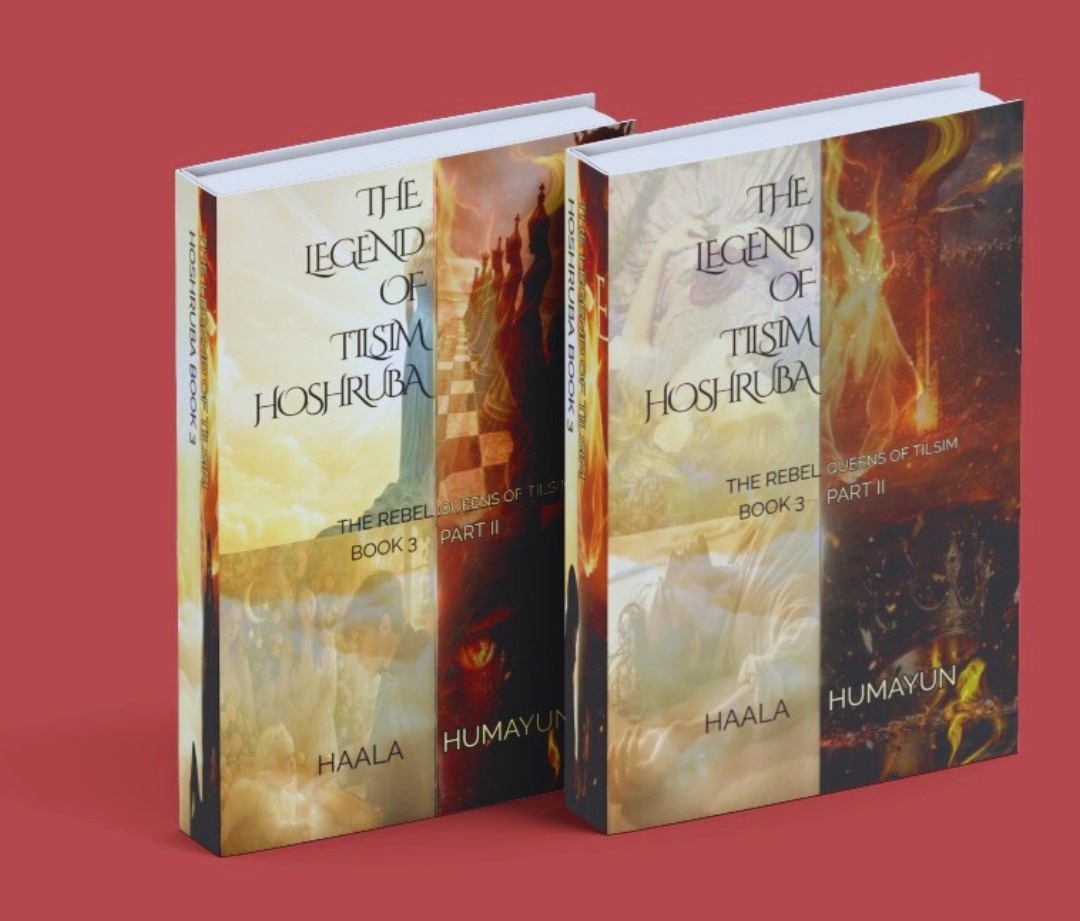
Book 3 — Completed and recently displayed at Sharjah Book Fair 2025.
This one is especially close to my heart, not only for its story but for its structure. It is divided into two sweeping parts — Part I: The Gathering Storm and Part II: The Fallen Crown — each carrying its own rhythm, its own revelations, and its own emotional weight. These two parts stand like twin waves: one rising, one crashing, together shaping a turning point in the Tilsim universe.
Book 4 — Currently in progress.
This is where the world expands. New lands, new secrets, new sorcery — and characters who finally meet the truths they have been running from. Writing it feels like walking into an ocean at night: vast, unpredictable, and breathtaking.
What was the hardest thing about writing your latest book?
The most difficult part — and the most delicate — was weaving faith, science, and fantasy magic together in a way that felt natural, seamless, and respectful to each realm. These three worlds often sit on separate shelves: faith speaks to the unseen, science explains the measurable, and fantasy breathes through wonder. Bringing them into one narrative without letting them contradict one another was like walking a tightrope in the dark.
I had to treat each element with honesty.
Faith demanded sincerity — not loud declarations, but the quiet truth that lives in the soul of a character.
Science required precision — every magical phenomenon needed a logic, a pulse, a reason that made the impossible feel almost… inevitable.
And magic needed freedom — room to breathe, to enchant, to remain mysterious without dissolving into chaos.
Balancing all three meant rewriting scenes over and over, adjusting lines, reshaping moments, and listening closely to the story’s heartbeat. I didn’t want the reader to feel pulled between worlds; I wanted them to feel as though these worlds were always meant to coexist — like different colors blending into one light.
It was difficult, yes. Many nights I felt like I was stitching together three different universes with a single, trembling thread.
But when it finally aligned — when faith supported the magic, when science strengthened the wonder, when all three held hands instead of fighting for space — that was when the story felt truly alive.
And that, I think, is the hardest part: letting three truths breathe together without silencing any of them.
Who is your favorite character in your book and why?
Umro Ayyar — without hesitation, without doubt, without the slightest pause.
He is the character who refuses to stay inside the neat little boxes readers expect. He is a storm I cannot predict, and yet a storm I cannot stop writing. Perhaps that is why he lives so vividly on my pages — because he is free in the way a writer secretly wishes to be.
Umro is not a hero.
But he is not a villain either.
He is the uncomfortable, magnetic, maddening space between right and wrong — the grey region where real human souls exist.
He can slit a throat without remorse if the situation demands it; he can deceive kings, manipulate sorcerers, trick destiny itself if he must. His hands are stained with choices most people would never dare make. And yet—when it comes to those few he truly loves, the ones who occupy that fragile, sacred space in his heart—he becomes a different man. Softer. Sharper. Human in a way that startles even him.
That contradiction is what fascinates me.
He is a puzzle built from knives and compassion, loyalty and danger, ruthlessness and tenderness. He forces the reader to question morality, and he forces me as the writer to explore the uncomfortable truth that even the darkest souls carry a flicker of light somewhere deep within.
In my recent novel, I allowed his greyness to unfold more boldly — and this time, I didn’t cage him. I let him roam. I let him make impossible choices. I let him break rules, bend fates, and walk the line between devotion and destruction.
And to portray that complexity, I used the exact combination that defines my entire world-building: faith, science, and magic woven together like threads of a single tapestry.
Because Umro Ayyar is not a creature of only one dimension; he is a man who interacts with destiny like a mathematician, with miracles like a believer, and with sorcery like a master of trickery. His intelligence is dangerous enough to destroy worlds—and brilliant enough to save them.
He is terrifying.
He is captivating.
He is deeply, painfully human.
And that is why he remains my favourite — because he is the kind of character who wakes up the moment I close my laptop, the kind who refuses to die just because a chapter ends, the kind who reminds me that the best characters are the ones who disturb you into thinking, feeling, and questioning your own definitions of good and evil.
What is the most important thing that people don’t know about your genre but that you would like for them to know?
I wish people understood that fantasy is not an escape from reality — it is a mirror that reveals reality more honestly than real life ever dares to.
Most readers look at fantasy and think, “Oh, magic… sorcery… mythical creatures. That must be fun, imaginary, disconnected from the real world.” But what they don’t see is the architecture beneath it — the skeleton of truth that holds the story upright.
Fantasy is not about dragons and spells.
Fantasy is about the human heart placed in extraordinary circumstances.
In my genre — which blends faith, science, mythology, and magic — every spell is actually a metaphor, every creature is a symbol, every prophecy is a coded message about who we really are when the world strips us bare.
People don’t realize how much research fantasy demands. You’re not inventing nonsense; you’re building an entire universe brick by brick — its logic, its physics, its culture, its moral boundaries. You can’t just say “magic happened.” You have to answer:
- Why did it happen?
- What does it cost?
- Who pays that cost?
- And how do faith and science and sorcery interact without contradicting each other?
This is the part readers rarely see — the invisible labor behind the spectacle.
To write believable magic, you must understand reality deeply.
To write a fictional world, you must study the real one intensely.
Fantasy is the most powerful genre because it gives you a safe place to confront the dangerous truths you avoid in everyday life. It allows you to ask questions that would feel blasphemous, frightening, or too vulnerable in a realistic setting — questions about destiny, morality, the unseen, the divine, the purpose of our existence.
When I blend Tilsim-world sorcery with physics, Quranic cosmology, biological concepts, and ancient folklore, it’s not because I want to impress the reader — it’s because magic, science, and faith are not enemies. They are languages describing the same reality from different angles.
And once readers understand that…
Fantasy stops being fiction.
It becomes revelation.
This is what I want people to know: fantasy is not an escape from life. It is life — distilled, magnified, unmasked.
A place where truth walks around wearing the face of magic so that we may finally dare to look at it.
What is your next project?
My next project is, of course, the fourth book of The Legend of Tilsim Hoshruba — a world that has become so vast, so breathing, so achingly alive that it now demands to be written in parts. InshaAllah, this book will unfold in three sections, each one expanding the realm in a way I have not attempted before.
If the earlier books introduced readers to the magic of Hoshruba, this next installment will take them inside its heartbeat.
For the first time, I am not just writing the adventures of heroes and sorcerers —
I am writing the civilization behind them.
This book will reveal:
- How the people of Hoshruba live — their homes, their cities, the rhythm of their days.
- Their customs and etiquettes — how they greet, how they mourn, how they celebrate, how they show respect.
- Their court systems — the hierarchy, the protocol, the political tensions hidden behind enchanted thrones.
- Their calendar — seasons with their own names, their own stories, their own spiritual meanings.
- Their timekeeping — how a realm shaped by magic measures dawn and dusk, months and moons.
- Their familial relationships — the unique words they use for mothers, fathers, siblings, elders, and loved ones.
- Their cultural philosophy — what they fear, what they worship, what they consider sacred or forbidden.
In this book, Hoshruba stops being a fantasy setting — it becomes a living civilization that could have existed on Earth, especially during the Umayyad era, connected through hidden portals that linked their world to ours.
This is the part I am most excited about: creating a fantasy realm so detailed and authentic that readers feel as if they could step through a doorway and find themselves walking its streets — hearing its market cries, feeling its seasons, learning its greetings, understanding its politics.
Tilsim Hoshruba is no longer just a world I invented. It is a world I am discovering — layer by layer, secret by secret.
And this next book, InshaAllah, will finally open those doors wide.
If your book was made into a movie, who would you cast?
If The Legend of Tilsim Hoshruba were ever brought to the screen, I would choose actors who could embody not just the appearance of my characters, but their essence — the depth, the contradictions, the fire, the fragility. And for that, I naturally find myself drawn toward Turkish actors, because their screen presence carries the perfect blend of nobility, intensity, and emotional nuance that my world demands.
For Prince Assad, I would imagine someone with a quiet, princely gravity — a face that holds storms behind softness, and courage behind restraint. Someone like Engin Akyürek or Burak Özçivit could portray that blend of dignity, loyalty, and emotional conflict that defines him. The kind of hero whose silence speaks louder than his words.
For Princess Mehjabeen, I see someone who carries grace the way a flame carries light — delicate, luminous, but strong enough to burn through illusion. An actress like Esra Bilgiç or Tuba Büyüküstün would beautifully capture her ethereal depth, her innocence threaded with inner strength, and the quiet sorrow that follows her like a shadow.
And then there is Umro Ayyar — the master of deception, wit, and unthinkable cunning. For him I would choose someone with sharp eyes and a mischievous intelligence, someone who can shift from charm to menace in a single breath. Çağatay Ulusoy or Kıvanç Tatlıtuğ would bring his grey-shaded complexity to life: the trickster who can slit a throat without hesitation, yet still kneel with human tenderness for the few he loves. A character whose loyalty is unpredictable, but whose brilliance is undeniable.
For the sorcerers, warriors, and rulers of Hoshruba, I imagine a cast filled with the grandeur of period Turkish dramas — faces that carry history, voices that can command a realm.
But more than looks, I would want actors who can portray the soul of my world:
the aching love, the moral storms, the whispers of magic, the clash between duty and desire.
If Tilsim Hoshruba ever becomes a film or series, I want it to feel like a place viewers could step into — a world that feels ancient, mysterious, and heartbreakingly alive. And I believe Turkish actors, with their emotional depth and timeless screen presence, could bring that vision to life beautifully.
Tell us something unique about you.
Something unique about me is that I live with two completely different souls inside one body — and both are equally real, equally loud.
One part of me is the lawyer: structured, analytical, detail‑oriented. She thinks in logic, speaks in evidence, and sees the world through the lens of reason. She can dissect an argument, read people’s intentions, and navigate chaos with calm discipline.
But the other part of me…
She is the storyteller — the unrestrained one.
The wild horse with no reins.
The girl who hears metaphors in silence and sees stories hidden between shadows.
She is driven not by logic, but by intuition — by the pull of destiny, emotion, and imagination.
And the unique thing is: I do not silence either one. I let them coexist.
Most people choose one path — either intellect or imagination. I walk both.
I can spend my morning drafting legal opinions grounded in evidence, and by evening I can be lost in an underwater realm of magic where emotions breathe and shadows whisper. I don’t switch between these worlds — I carry them together. My logic strengthens my fantasy, and my imagination softens my logic. They feed each other, challenge each other, complete each other.
Another unique thing about me is the way stories come to me. I don’t “decide” to write — the story decides. It arrives unannounced, knocks once, and if I ignore it, it becomes louder until I finally sit down and give it life. My characters behave the same way — stubborn, demanding, and emotionally wild, much like their creator.
And perhaps the strangest, most beautiful truth is this: I don’t create stories — I witness them. As if they already exist somewhere in another realm, and I am only the one allowed to peek in and translate them into words.
So if there is something unique about me, it is this duality — a mind trained to argue logic
and a soul determined to chase magic — living in harmony, constantly pulling each other toward a more beautiful, balanced truth.
That blend is the heartbeat of everything I write.
Want to learn more about Haala Humayn?

 Waking Writer
Leave a Comment