Can you share a little bit about your latest book?
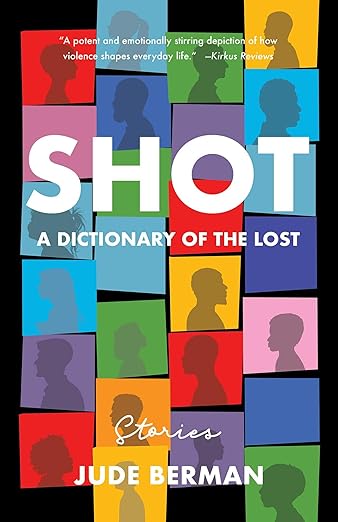
My latest book is Shot: A Dictionary of the Lost, a collection of short stories about the epidemic of gun violence. It is organized like a dictionary, with one chapter for each letter of the alphabet. So, A for Anna, B for Benjamin, C for Chester, etc.
The stories are all fictional, and characters represent all ages and regions and political persuasions. The common denominator is their tragic involvement in a moment of violence.
You might think this sounds like a violent book, but I would say it’s less violent than your average TV drama. There’s no gratuitous violence. The stories primarily show what happens in the days and minutes prior to a mass shooting event.
Each character has stuck with me, like actual humans I’ve met. I’m hoping they will speak to readers too, giving the message that gun violence isn’t something that happens to someone else, somewhere else, because they failed to guard against it. No, it can happen to anyone. Even you.
What made you decide to sit down and start writing this book?
The idea came to me after a school shooting—the latest one at the time. At first, I nixed the idea. I was afraid people would think fictional stories about gun violence would be too depressing to read.
However, the characters started coming to me and telling me their stories. They persisted until I couldn’t keep saying no. They convinced me their stories weren’t necessarily too violent or too depressing, and the people needed to hear them.
I also came to see their stories as celebrations of life. Though the characters are fictional, it is as if they are standing in—and standing up—for the real people who have died, and telling me I need to stand up for the same reason.
Are you a full-time or part-time writer, and how does that affect your writing?
I started out as a full-time editor of other people’s books and a part-time writer of my own. If that sounds like it adds up to more than 100%, it does. Because I had to put clients’ needs first, my own writing often suffered as a result.
In the last few years, I’ve been able to make prioritize my own writing, while not neglecting the clients I still have. Even so, it still probably adds up to more than 100% time. But that’s my choice.
I would say that editing other people‘s books helped me with my own writing. I’m able to write a first draft that look like many people’s copyedited manuscripts, which makes life easier because I don’t have to bring in another editor.
What have you written so far?
I have published two novels: The Die and The Vow. I’m currently working on a sequel to The Die.
How long does it take you to write a book?
I discovered I can write a book in nine months to a year.
It hasn’t always been like that. My first book (The Vow) took 30 years from inception to publication. Of course, I wasn’t writing all that time. The book went through many revisions, including rewriting every sentence from present tense to past tense, and then later on, rewriting it back in the other direction. I learned a lot about writing from that!
Mostly, though, the idea for a book comes to me in a very brief instant, almost like it drops fully conceived from the ether into my mind. I don’t spend much time figuring out the substance at the macro level; it’s more about getting down the details and then reworking and reworking and reworking everything at the micro level.
What inspires you to write?
I am mostly inspired by the events—the injustices and violence and disasters—that I see in the world around me and that threaten the future of humanity. I want to write about these issues in a way that can help us better deal with them.
As individuals and collectively, we can do so much more, yet often we don’t quite know what to do. Or we fear that we may not succeed, so we don’t even try. Sometimes we’re not aware of problems even when they’re bearing down on us.
So I write to shed a light on all of this, with the hope that in some small way, my words can make a difference.
Why did you choose to write in your genre?
I consider myself a cross-genre author. I’m not a great fan of genres in general, but if I have to choose, I would categorize most of my books as political fiction because they deal with social issues.
At the same time, because I bring a philosophical perspective to my writing (and to my politics), I would say I write metaphysical/visionary fiction. Those are two genres that most people probably regard as incompatible. But I don’t. In fact, one of the driving forces behind my writing is the desire to bring those two perspectives together.
What is the biggest thing that people think they know about your genre?
People tend to think that a cross-genre author writes books that combine two easily compatible genres. For example: historical romance, science fantasy, mystery thriller. They think the genres should be evenly balanced. People also think writers should write all their books in the same genre—or the same type of cross-genre, if that’s what they’re doing.
Anyone with either of those presumptions would be wrong about me. For example, my cross-genre book The Die combines speculative fiction, political fiction, and metaphysical/visionary fiction. On the other hand, The Vow is both historical fiction and literary fiction. The Die takes place in the near future, while The Vow is set in the 18th century.
When I do meet and greets, I like to ask readers, “Are you a future person or a past person?” Depending on what they say, I direct them to one or another book.
What is the most important thing that people don’t know about your genre but that you would like for them to know?
I would like people to realize that genres are largely an artifact of the publishing industry’s need to deal with the deluge of self-published books. In fact, the whole emphasis on genre that we see now is a very recent phenomenon if you consider the history of literature.
Why is this important? Because many people end up stuffing their writing into the straightjackets of genre, and that doesn’t serve anyone. Recently, I wanted to submit my new book, Shot: A Dictionary of the Lost, to a marketing website that offered a menu of genre choices, and none of them fit.
All of this is to say that we would do better to place less importance on genre and more importance on the quality of writing, the power of our characters, and the messages conveyed by our books.
If there was one thing you could do to change the publishing and literary world, what would it be?
In addition to changing how the publishing and literary world uses genre, I would like to change the industry’s practice of favoring books they think will be bestsellers over books they know have the highest quality of writing.
This didn’t used to be the case. Back in the day, publishers used their income from bestsellers to support the books they believed in. Yes, sometimes the books they believed in were bestsellers. But not necessarily the best books.
Of course, this is an economic/financial issue. I’d like the publishing industry to make it their priority to fix that. For the sake of our civilization’s future, I really hope they find a way to do so.
Want to learn more about Jude Berman?

 Waking Writer
Leave a Comment